


Interview about Xylitol and its possible effects on human health with expert Dr. Ing. Eliška Kováříková, Ph.D. from the National Center for Agricultural and Food Research, vvi
First of all, I would like to introduce myself to you. My name is Jiří Samuel, I am the CEO & Founder of healthychewinggum.com and healthchewinggum.com and for over 10 years I have been dealing with chewing gum, its incredible health benefits, composition or ingredients in commonly available chewing gum and in its healthier alternatives – chewing gum without harmful chemicals and without plastic materials. For many years I was dissatisfied with the composition of chewing gum on our and foreign markets (globally). I started looking for healthier alternatives that would meet the basic requirements for the quality of raw materials and processing of chewing gum and pastilles. I wanted chewing gum without any harmful chemicals and without plastic materials. And that was not and is not, even today, an easy task.
Chewing gum without harmful chemicals and without plastic materials
I was lucky enough to come across chewing gums and lozenges that met my more demanding expectations. What surprised me the most was that even these natural variants without plastic materials and harmful chemicals actually taste and smell great. The smell of these chewing gums is real, no artificial synthetic perfume. Cinnamon chewing gums smell and taste like cinnamon, mint chewing gums smell and taste like mint, fruity……..
Aspartame-free chewing gum
But back to the topic. My original most important parameter was the composition. Most chewing gums on our and foreign markets contained aspartame – an artificial sweetener . And I wanted to change that – to offer the market something different – healthy.
The World Health Organization (WHO) classified aspartame as a potential carcinogen in 2023.
Aspartame was considered potentially carcinogenic at the time I was looking into the composition (2016). In 2023, the World Health Organization (WHO) classified aspartame as a potentially carcinogenic substance (Group 2B). The WHO must have had serious reasons for this. Aspartame was and still is widely used in the food industry.
The most suitable substitute for aspartame – Xylitol
I was looking for other sweeteners that could replace aspartame and sugar. The range of sweeteners is wide, and the information about them is often inaccurate, often biased. After a few weeks, my list narrowed down. And I already knew that I had found the most suitable candidate – the natural sweetener Xylitol .
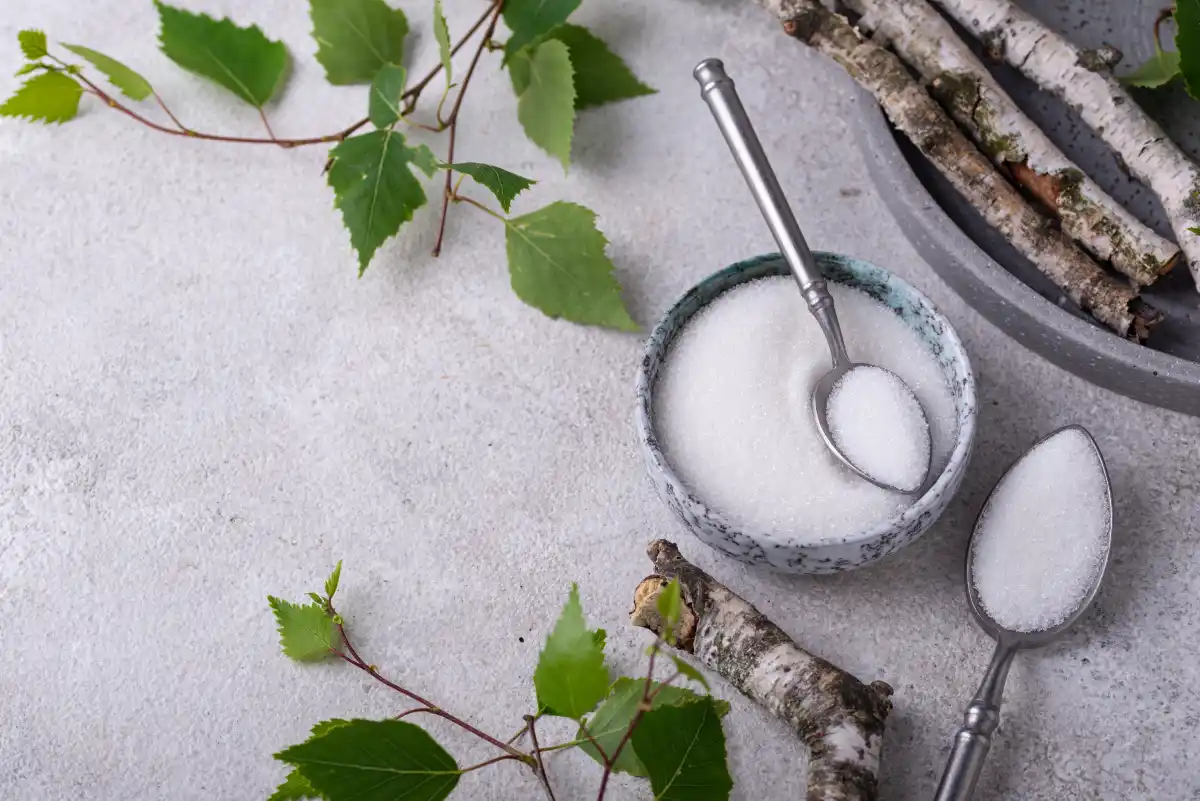
I consider Xylitol to be the best natural sweetener substitute in chewing gum and lozenges/candies. This sweetener, extracted mainly from birch, has many health benefits for us. If we use it wisely and do not overdo it, we can use it to our advantage without side effects, which cannot be said about other sweetener substitutes, often synthetic ones, that are commonly found on the market.
Interview with an expert on Xylitol
That was also the reason why my main intention was to have Xylitol included in all our products – in chewing gum, lozenges and spray. And so that my opinion was not only supported by independent studies and also my own long-term experience with chewing and sucking our products, I arranged with Ing. Eliška Kováříková Ph.D. to meet with me and answer a few of my questions. Independently and objectively. We met by chance at the Earth the Provider exhibition in České Budějovice in 2024. We met there, and I was very happy to be able to talk about Xylitol with a real expert.

We arranged a meeting and I planned a trip to Prague to the National Center for Agricultural and Food Research, vvi . It wasn’t an hour-long meeting as we both had planned, but it dragged on a bit. I selected the most interesting questions and answers that resonate with me to this day.
A compilation of our questions and answers on the topic of Xylitol and its possible effects on human health:
1) Can I tell my customers that the natural sweetener Xylitol is among the best substitute sweeteners on the market today?
You can basically say whatever you want as long as it doesn’t harm anyone. Xylitol as a sweetener shouldn’t harm anyone if consumed in moderation. Large doses can have laxative effects on sensitive individuals, but we’re talking about 50-90g per day.
This means that an adult can have 40-50 chewing gums and 80-90 lozenges per day (converted to our Xylichew chewing gums and XyliDENT lozenges ). According to studies, for children it is about half, i.e. 20-25 chewing gums and 40-45 lozenges per day. Of course, everyone can fit in there. (comment by zdravezvykacky)
However, unlike other sweeteners, including sugar, xylitol has undeniable advantages. It is digestible for us, although in a different way than sugar, which means that our body is not completely disappointed by the sweet taste. Xylitol is therefore suitable for diabetics, but at the same time it does not burden our excretory system as much as sweeteners, which our body cannot cope with.
2) What do you see as the most interesting benefits of Xylitol for the human body when consumed sensibly?
Xylitol can be digested by both us and our gut bacteria. There are studies that suggest that xylitol does not bother our friends in the gut, which in my opinion is an important aspect of any new ingredient that we want to introduce into our diet. Xylitol is known in nature, what is new about it is only the amount that we can offer to the body thanks to modern technologies. So here too, moderation and not overdoing consumption are in order. Where the body is no longer functioning as it should, for example in diabetes, xylitol is an interesting alternative.
3) Do you think it is possible to say that Xylitol is able to positively influence the human microbiome?
I haven’t found any evidence for this claim yet, but the fact that it is not harmful even with long-term consumption is enough for me. Here we are talking about at least twenty years of consumption. Only a balanced diet consumed in reasonable quantities and adequate physical and perhaps mental activity can positively influence the microbiome.
4) Can chewing gum with xylitol have a preventive effect on the formation of dental plaque? Can it reduce the incidence of tooth decay by up to 40%, of course, if people brush their teeth regularly or do you think it’s just a rumor?
Xylitol has a proven limiting effect on bacteria that form dental plaque and subsequently cavities. In the form of chewing gum, we can “hold it” in the mouth and the mechanical effect of the chewing gum itself is certainly included in the overall positive balance. However, it is more appropriate to consult with dental experts on this. My opinion is based on scientific studies that always study a partial problem. It is necessary to take into account that dental care is a complex matter.
5) If I chew gum wisely, for example 3-4 times a day, do you think this can reduce the incidence of common respiratory diseases – colds, nasal and ear infections?
There is a proven effect (clinical study https://doi.org/10.1542/peds.102.4.879 ) that was found for both syrup with xylitol and chewing gum. With daily use, the incidence of otitis media was reduced compared to the group with control syrup and chewing gum. So it seems that yes, this effect is possible, but it clearly will not always work and treating acute inflammation only by chewing is nonsense. We know that xylitol works well against certain types of bacteria, but colds and inflammations have multiple causes. However, every acute inflammation definitely belongs in the hands of doctors, especially when it concerns a child. Xylitol in chewing gum can be recommended as part of prevention, which should be based on a reasonable lifestyle.
6) Is it possible that chewing gum with Xylitol could improve the condition of the oral cavity?
Yes, it is possible. Xylitol prevents bacteria from forming plaque on the teeth and weakens them overall. This reduces the stress on the teeth and makes them easier to keep clean. Our natural mouth protection mechanisms can intervene more effectively against other unwanted invaders.
7) I have noticed that after 3 years of chewing gum with Xylitol, my teeth are not discolored as I used to. To my surprise, both my dentist and my dentist noticed this. The condition of my teeth, gums, dental plaque and pigments, which I always had problems with during my visits, is gone. I received compliments from them, and the only thing I changed was that I started chewing regularly. Is it possible that chewing gum with Xylitol helped me with this?
It is possible, xylitol apparently helped to set the internal balance between the bacteria inhabiting the oral cavity. By acting only on a certain group of bacteria and not harming others, it could have given room for the development of other species, which, however, do not support the formation of dental plaque as much. The second significant effect is the chewing itself and the production of saliva. So it is a question of which effect was the main one, but I believe that it was their interplay.
8) We recommend our products to all ages, including children. Is this okay in your opinion?
Recommending sweets, even sugar-free ones, to children is a highly controversial topic. They definitely do not belong in the diet of very young children who are just discovering the world of tastes and smells. Not because of xylitol, but because of generally healthy eating habits. With chewing gum and lozenges, it is of course important to consider the risk of inhalation first and foremost, i.e. how a child will cope with something in their mouth that they should not swallow right away. It is also necessary to realize that the laxative limit is calculated for an adult, so for children it is necessary to count on a lower dose (this probably does not apply to chewing gum, but in general to the use of xylitol instead of sugar).
When older children start to discover the world of chewing and sucking, we can offer them these variations with xylitol. If there are health problems in the family that xylitol could help with, then it is appropriate to try chewing gum or lozenges in a reasonable amount as a preventive measure. However, once again, a sensible lifestyle is the basis and xylitol should be seen as a supplement.
Even though Xylitol is currently considered by the professional community, and we also consider it to be one of the best natural sweeteners, it is necessary to say that nothing should be overdone, not even with Xylitol. Eat healthy and balanced. Do not forget about a varied diet. Your diet should include fruits and vegetables. Do not avoid healthy exercise, which is also very important for our bodies.
Xylitol: Support from a nutrition expert
The natural sweetener Xylitol, obtained mainly from birch, is not only a safe alternative to sugar, but also offers a number of health benefits. I discussed its effects with Ing. Eliška Kováříková, Ph.D., an expert from the National Center for Agricultural and Food Research, vvi, who confirmed its benefits. She emphasized that Xylitol is suitable for diabetics because it does not burden the metabolism like sugar, and has proven effects in preventing tooth decay. However, she warned against excessive consumption, which can cause laxative effects. Its use as a natural sweetener should be part of a balanced lifestyle, which includes a varied diet and regular exercise. According to Dr. Kováříková, Xylitol can be a functional supplement to a healthy lifestyle.
Thanks
I would like to thank Dr. Eliška Kováříková, Ph.D. from the National Center for Agricultural and Food Research, vvi, for her contribution not only to this interview, but also to me personally. Our conversations were very beneficial for me not only from the perspective of xylitol, chewing gum, but also a healthy lifestyle.
Ing. Jiří Samuel, CEO & Founder healthychewinggum.com/zdravezvykacky.cz